
Engineers based in India are estimated to be writing roughly 35 per cent of the 100 million lines of codes required to develop one fully driverless car for global vehicle makers.

With a million-odd electric vehicles (EVs) - two-wheelers, e-rickshaws, buses and passenger cars - expected to hit the road this calendar year, the shift from gasoline-powered vehicles has become irreversible. Now the question is whether the supply chain is ready for this shift. Key components - the high-powered lithium-ion battery and the cells which go with it, the electric motor, and the electronics powered by chips - account for nearly 60 per cent of the cost of an EV.

Ola Electric has finalised its second phase of expansion, under which it will increase its plant capacity fourfold - from 1 million two-wheelers per annum to 4 million. This will also include motorcycles, said a top executive of the company. It will also build a plant with a 5 Gwh of advanced chemistry cell battery storage capacity in the same super factory located on the outskirts of Bengaluru.

'The current launch is a sounding rocket, this cannot be called a milestone. The importance is this is for the first time a private player is doing it.'

Home-grown companies, including electronics manufacturing services (EMS) firm Dixon Technologies and mobile device maker Lava International, have started exploratory talks with Chinese sub-assemblies and component players for setting up joint ventures (JVs) in the country. Sources in the industry say many domestic companies have also had preliminary discussions with original design manufacturers (ODMs) in China to look at a JV model for manufacturing smartphones. Key ODM players in mobile devices in China include Longcheer, Huaqin, and Wingtech, which has already set up a plant in Tirupati.

The Department of Telecommunications (DoT) has asked Vodafone Idea (Vi) to come back to it with a business plan soon in light of its decision not to launch 5G services for now (unlike its competitors Reliance Jio and Bharti Airtel) and in view of its assessment of the possible impact of BSNL's impending launch of 4G in a few months and then 5G by August 15. "We are worried about Vi as we want to have three private players and one government player in the market. "The global trend now is to have two to three players.

The users of 5G-enabled Apple iPhones will be able to try 5G telecom services - wherever available publicly in the country - from next week, both on standalone (Reliance Jio) and non-standalone networks (Bharti Airtel). Airtel and Jio customers who download the iOS 16 Beta software update as part of its 'Apple Beta Software Program' can try the service and send their feedback to the company. The final updated software will become available sometime in December.

Start-up entrepreneurs nearly doubled their contribution to philanthropy in 2022 but their numbers shrank. They decreased to only three (from five) in the top 100 of the Edelgive Hurun India Philanthropy List of 2022 which was released on Thursday. Over the year, no new start-up whizz kid joined the list either. The three start-up entrepreneurs who made it to the list contributed collectively Rs 166 crore in FY22, nearly double that of Rs 83 crore in FY21.

Mamallapuram's Group of Monuments -- a collection of 7th- and 8th-century religious structures -- attracted 46 per cent of the total foreign tourists who visited India compared to 12 per cent by the Taj.

On Sunday, at 12.07 am in Sriharikota, off the coast of the Bay of Bengal, it was almost like an early Diwali, with the sky lit up by the launch of 36 OneWeb satellites. The Indian Space Research Organisation (Isro) did the launch on a 43.5-metre-tall Geosynchronous Satellite Launch Vehicle Mark III (GSLV Mk III) rocket. After the countdown, which started 24 hours in advance, once the mega screen marked the launch, a select group of invitees at the gallery cheered by applauding the feat.

Spectrum allocation for satellite services came up as a dominant theme at the launch of 36 communication satellites by OneWeb, a Bharti group venture, here on Sunday. Following the launch, Bharti Enterprises chairman Sunil Mittal, in a conversation with a group of reporters, reiterated that spectrum auction did not make sense in the case of satellite services. "This (satellite services) is not competing with mobile services where you can justify the auction.

With India rolling out 5G services, can telcos get the sizeable 350-400 million 2G customers to upgrade to 4G, or even better -- but very improbably -- straight to 5G?
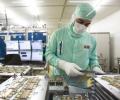
Mumbai-based Indian Semiconductor Manufacturing Company (ISMC) and Singapore-headquartered IGSS Ventures have one strategy in common: They have told the government in their application for semiconductor fabrication plants that they will export the bulk of the chips they make in India in the initial five or 10 years. The third applicant, Vedanta-Foxconn, which is also building a fab plant, has said it will concentrate on the needs of consumer electronics and mobile device markets, and earmark 80 per cent of output for domestic consumption, but has not specified its customers. Finding a viable domestic market could well be the biggest challenge for India's renewed tryst with semiconductors. Fab plants do not sell directly to end users but to intermediary chip design companies - such as Qualcomm or MediaTek.

Reliance Jio may not ask for a premium for its 5G services in the initial stages of the launch, according to sources in the company. The company will roll out 5G commercial services in four cities -Delhi, Mumbai, Chennai, and Kolkata - around Diwali this month and slowly ramp up the processes for other cities, too. A senior executive, when asked whether Jio will charge higher tariffs for 5G against 4G, said: "In the initial stages, customers have to adopt 5G, then they will have to find value in the service, and then one can look at monetisation."

The Apple iPhone comprises 44 per cent of the global smartphone market's revenues and it is the second most-such device to be shipped after Samsung. More than half of smartphones used in the US are iPhones. More than 7 million iPhones are expected to be sold in India in 2022, extending the user base to 20 million, according to market research and analyst firm Techarc. Hence, the news about Apple scaling down its production target for iPhone 14 in India has made news.

Driven by a rise in sales during the current year, German luxury carmaker Mercedes-Benz said on Thursday that the company is expecting a growth in sales of around 8-10 per cent in the next few years. This comes at a time when the company is ready to surpass the previous highest sales of 15,538 vehicles (2018) in 2022. During the first half, the company sold 7,600 units. It already has an order bank of around 7,000 vehicles. In 2021, the company sold 11,242 vehicles.
India will have 30 per cent of its two-wheeler industry turning electric by 2030 as new manufacturers lead the shift, said a report on Monday. Passenger vehicles will be 15 per cent electric and the three-wheeler segment 75 per cent electric by 2030, said the report by BNP Paribas called 'India Autos-Electric vehicles: Minutes to midnight'. "We see FY22 as the year of inflection for the two-wheeler EV industry, with an accelerated EV adoption helped by incentives, wider availability, model launches, rise in crude prices and improved general awareness. We see 30 per cent of the 2W industry turning electric by 2030; the pace of incentive withdrawal presents an upside/downside risk," the report (India Autos - Electric vehicles: Minutes to midnight) said.

'Every telecom user wishes to know who is calling. This will help in preventing cyber frauds using telecom services.'

'This year there is a sharp spike in fever cases, and it seems to be more than the pre-COVID-19 levels.'

Reliance Industries (RIL) has been distilling its investment strategy to meet new goals. The share of the new energy vertical - its key focus area - accounts for more than a fourth (26 per cent) of the total war chest of $6.4 billion, ploughed into acquisitions and picking up stake from 2018 to date, reveals the latest Morgan Stanley data. Nearly half the incremental investments made on deals by RIL between August 2020 and September this year ($3.3 billion) has been spent on new energy - acquiring global companies with technology and expertise.
 © 2026 Rediff.com - Advertise with us - Disclaimer - Privacy Policy - Sitemap - Feedback - About us - Terms of use - Grievances